
Table of Contents
ToggleZomato Success Story: How Deepinder Goyal Built a Food-Tech Giant
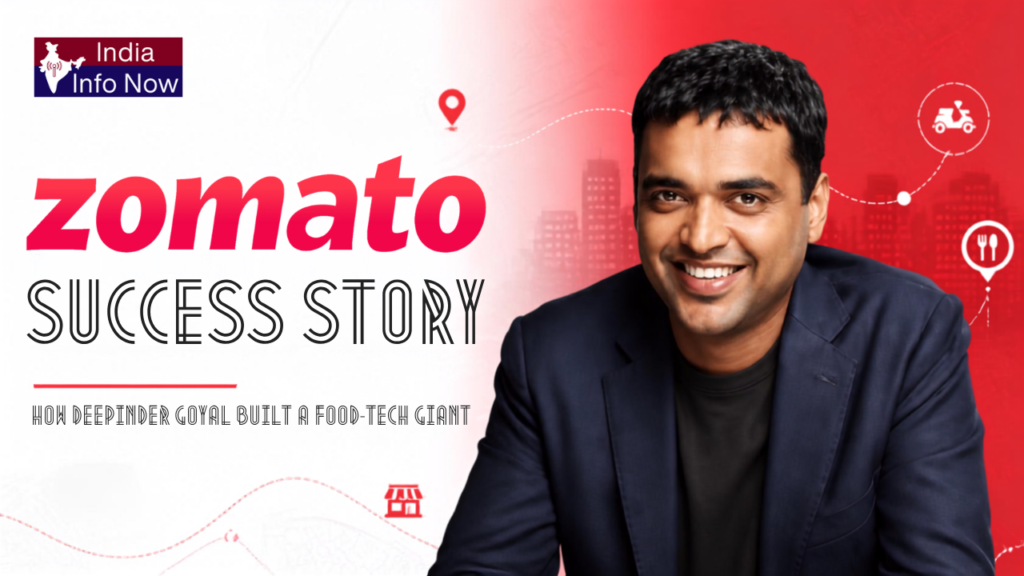
How Zomato Started: A Simple Problem and a Big Idea
Deepinder Goyal studied Computer Science and Mathematics at the Indian Institute of Technology (IIT) Delhi, graduating in 2005. After completing his education, he worked at Bain & Company in Delhi.
It was during this period that the idea behind Zomato began to take shape.
Employees in the office frequently searched for restaurant menus when deciding where to eat or order food. Restaurant menus were often available only in physical form, and people had limited access to information about restaurants, prices, locations, and dining options.
Deepinder Goyal recognized that technology could solve this problem.
Together with Pankaj Chaddah, he began developing a platform that could bring restaurant information into one convenient digital location.
In 2008, they launched Foodiebay, a website designed to provide restaurant menus, information, reviews, and ratings. The idea was straightforward: help people make better and more informed decisions about where and what to eat.
At the time, India’s food-tech ecosystem was still in its early stages. The concept of using an online platform to discover restaurants and access menus was relatively new for both consumers and restaurant owners.
From Foodiebay to Zomato
After gaining early traction, Foodiebay was eventually rebranded as Zomato.
The new name was short, memorable, and easier to build into an international brand. The rebranding became an important step in the company’s long-term growth strategy.
Zomato initially established a strong presence in Delhi and the National Capital Region before expanding to major Indian cities, including Mumbai, Bengaluru, Chennai, Pune, Ahmedabad, and Hyderabad.
As internet usage and smartphone adoption increased across India, the company found new opportunities to expand its services and reach more customers.
The platform gradually developed from a restaurant discovery website into a much broader food and technology business.
Expanding Across the World
Zomato’s ambitions soon extended beyond India.
Beginning in the early 2010s, the company expanded into several international markets, including countries in the Middle East, Asia, Europe, Africa, and other regions.
Its international expansion included markets such as the United Arab Emirates, Sri Lanka, Qatar, the United Kingdom, the Philippines, South Africa, New Zealand, Turkey, Brazil, Indonesia, Portugal, Canada, Lebanon, and Ireland.
To strengthen its international presence, Zomato also pursued acquisitions and partnerships. The company acquired several restaurant discovery businesses, including Urbanspoon, helping it enter new markets such as the United States and Australia.
However, international expansion also brought significant challenges. Operating across multiple countries required the company to understand different customer preferences, restaurant industries, regulations, and competitive environments.
Over time, Zomato re-evaluated its global strategy and focused more strongly on markets and business opportunities where it could build sustainable operations.
The Biggest Challenge: Changing Consumer and Restaurant Behaviour
One of Zomato’s most significant early challenges was convincing people that restaurant information belonged online.
Before digital restaurant platforms became popular, consumers depended heavily on word-of-mouth recommendations, newspapers, printed menus, and personal visits.
Restaurant owners were also initially uncertain about the value of digital platforms.
Many businesses relied on traditional advertising methods such as newspaper advertisements, flyers, and customer recommendations. Paying for online visibility was a relatively unfamiliar concept.
Zomato had to demonstrate that a strong digital presence could help restaurants reach more customers and potentially increase their business opportunities.
Changing this mindset required patience, education, and continuous improvement of the platform.
The company’s early growth demonstrated an important entrepreneurial lesson: sometimes building a successful business requires not only creating a product but also changing how an entire market thinks and behaves.
Entering the Food Delivery Business
A major turning point came in 2015, when Zomato entered the food delivery business in India.
Initially, the company partnered with hyperlocal logistics businesses to deliver food from restaurants that did not have their own delivery systems.
Later, as the business expanded, Zomato developed stronger logistics capabilities. Its acquisition of Runnr helped support the transition toward a more integrated delivery operation.
Food delivery transformed Zomato’s business model. Instead of simply helping customers discover restaurants, the platform increasingly became directly involved in connecting customers, restaurants, and delivery partners.
Zomato Gold and New Services
Zomato continued experimenting with new products and services.
In 2016, the company introduced table reservation features in India. In 2017, it launched Zomato Gold, a paid membership programme offering dining and food-related benefits at participating restaurants.
The company also experimented with additional services during different periods, including grocery delivery and other consumer-focused offerings.
Some initiatives were successful, while others were eventually discontinued. This reflects another important aspect of entrepreneurship: successful companies often experiment, learn from results, and adjust their strategies.
One of the major developments in Zomato’s history came in January 2020, when it acquired Uber Eats’ India business in an all-stock transaction.
Following the deal, Uber Eats discontinued its standalone operations in India, and users and restaurant partners were transitioned to Zomato’s platform.
The acquisition strengthened Zomato’s position in India’s highly competitive online food delivery industry.
Growth During the Pandemic
The COVID-19 pandemic created enormous challenges for restaurants and food-related businesses. At the same time, demand for online ordering and contactless services increased.
Zomato responded by introducing and expanding several services, including grocery and essentials delivery through Zomato Market in multiple Indian cities.
The company also promoted contactless dining and other technology-driven solutions.
This period demonstrated the importance of adaptability during unexpected business challenges.
Lessons from Deepinder Goyal Business Journey
The Zomato journey offers several valuable lessons for entrepreneurs:
- Start by solving a real problem.
- Technology can transform traditional industries.
- Changing customer behaviour takes time and persistence.
- A strong brand can help businesses expand internationally.
- Experimentation is essential for innovation.
- Not every business idea will succeed, but failure can provide valuable lessons.
- Successful companies must adapt to changing markets.
Zomato Success story: Conclusion
The story of Zomato is one of innovation, persistence, experimentation, and transformation.
What started in 2008 as Foodiebay, a platform designed to make restaurant menus and information more accessible, evolved into one of India’s most prominent food-tech businesses.
Deepinder Goyal and Pankaj Chaddah identified a gap in a traditional industry and used technology to address it. From restaurant discovery to food delivery, international expansion, acquisitions, and new business experiments, Zomato’s journey demonstrates how a simple idea can evolve into a major business.
The Zomato success story continues to inspire entrepreneurs because it proves that solving an everyday problem with the right technology, persistence, and vision can create a powerful and lasting business.
Frequently Asked Questions
1. Who is Deepinder Goyal?
Deepinder Goyal is an Indian entrepreneur best known as the founder and leader behind Zomato, one of India’s leading food-tech and online food delivery companies.
2. Who founded Zomato?
Zomato was founded by Deepinder Goyal and Pankaj Chaddah. The company originally started as Foodiebay in 2008 before being renamed Zomato.
3. When was Zomato founded?
Zomato was founded in 2008 under the name Foodiebay.
4. What was Zomato originally called?
Before becoming Zomato, the company was called Foodiebay.
Most Popular
-
 தேர்வு நேரத்தில் குழந்தைகளுக்கு கொடுக்க வேண்டிய 10 மூளை ஆரோக்கிய உணவுகள்
 -
 அசைவ உணவுக்கு இணையான சத்துக்கள் தரும் சைவ உணவுகள் என்னென்ன?
 -
 நெல்லிக்காய் சாறு நன்மைகள் | Amla Juice Benefits in Tamil
 -
 காய்ச்சல் இருக்கும்போது குளிக்கலாமா? செய்ய வேண்டியது, தவிர்க்க வேண்டியது
 -
 சளி, இருமல் வராமல் இருக்க என்ன சாப்பிடலாம்? நோய் எதிர்ப்பு சக்தியை அதிகரிக்கும் உணவுகள்