
Table of Contents
ToggleWhat Is Compound Interest? How Small Savings Grow Over Time
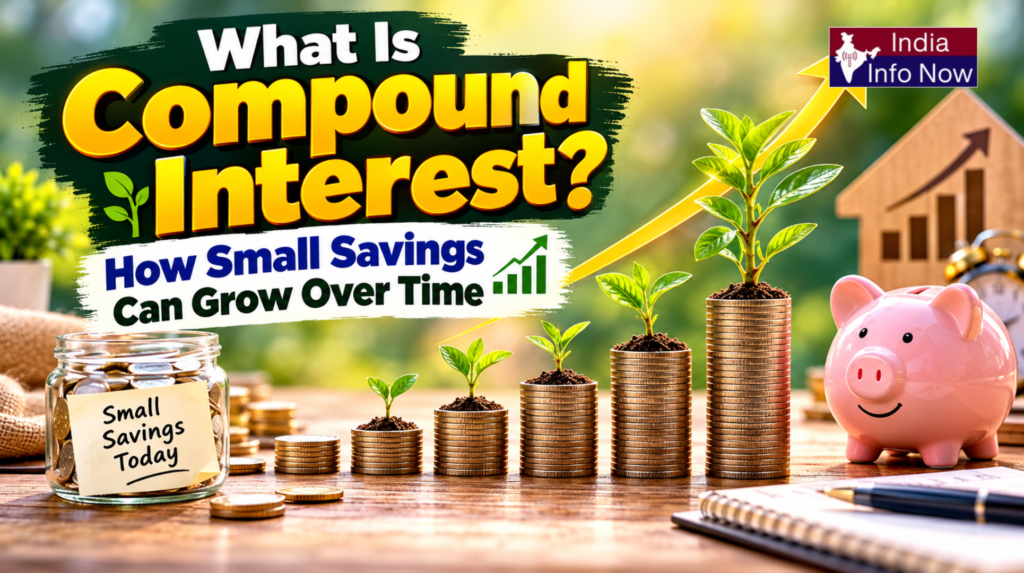
What Is Compound Interest?
Compound interest is the interest calculated on your initial investment as well as the interest accumulated from previous periods. In simple terms, it is often described as earning interest on interest.
Consider saving ₹10,000 in an account that offers 5% annual compound interest. At the end of the first year, you earn ₹500 in interest, bringing your balance to ₹10,500.
During the second year, the interest is calculated on ₹10,500 rather than just the original ₹10,000. You earn ₹525, taking your balance to ₹11,025.
The following year, interest is calculated on this higher amount. As the balance grows, the interest earned can increase as well.
This creates a cycle in which your accumulated earnings generate additional earnings. Although the growth may appear small initially, the effect can become more significant over longer periods.
How Does Compound Interest Work?
Compound interest depends on four important factors:
Principal amount: The money you initially invest or deposit.
Interest rate: The annual rate at which your money earns interest.
Compounding frequency: How often interest is added to your balance, such as annually, quarterly, or monthly.
Time: The number of years your money remains invested.
Generally, a higher interest rate, more frequent compounding, and a longer investment period can increase the final amount, assuming other factors remain unchanged.
However, actual returns depend on the financial product you choose. Bank deposits may offer a specified interest rate, while mutual funds and stocks have market-linked returns that are not guaranteed.
How to Calculate Compound Interest
You can estimate compound growth using the following formula:
A = P (1 + r/n)^(nt)
Where:
A = Final amount, including interest
P = Initial investment or principal
r = Annual interest rate expressed as a decimal
n = Number of compounding periods per year
t = Investment duration in years
To calculate compound interest alone, subtract the original principal from the final amount.
Example: How ₹10,000 Can Grow Over Time
Suppose you invest ₹10,000 at an assumed annual compound interest rate of 5%, with interest compounded once a year.
These figures assume a constant 5% annual rate, no additional deposits, and no withdrawals, taxes, or fees.
The example demonstrates how the same initial investment can grow over time simply by allowing interest to accumulate. Actual returns may differ depending on the product, its terms, and applicable taxes.
| Investment period | Approximate balance |
|---|---|
|
Initial investment |
₹10,000 |
|
After 1 year |
₹10,500 |
|
After 2 years |
₹11,025 |
|
After 5 years |
₹12,763 |
How Small, Regular Savings Can Build Wealth
Compound interest becomes particularly useful when you combine it with regular contributions. Instead of investing a large amount at once, you can save a manageable sum every month and gradually build your investment balance.
For example, imagine investing ₹1,000 every month for 20 years. Your total contributions would be ₹2.4 lakh. If those contributions earned an assumed annual return of 8%, compounded monthly, the accumulated amount could reach approximately ₹5.9 lakh.
This is only an illustration, not a guaranteed return. The actual amount will depend on the investment, contribution timing, expenses, taxes, and rate of return.
The important lesson is that consistency and time can matter as much as the amount you start with. Increasing your monthly savings whenever your income rises can further improve your long-term results.
1. Helps Build Long-Term Wealth
Compounding allows accumulated earnings to generate additional earnings. Over long periods, this can help your savings grow faster than they would under a simple-interest arrangement with the same rate and principal.
2. Rewards Starting Early
Starting early gives your money more time to compound. Even if you begin with a small amount, investing consistently over several decades may help you build a larger financial reserve.
3. Encourages Consistent Saving
Regularly setting aside money can develop financial discipline. When you combine this habit with reinvestment, you create an opportunity for your savings to grow over time.
4. Supports Important Financial Goals
Compounding can help you prepare for long-term goals such as retirement, higher education, buying a home, or building a financial cushion for your family.
5. Reduces Dependence on Large Initial Investments
You do not necessarily need a large sum to begin saving. Starting with an affordable amount and increasing contributions over time can be a practical approach for beginners.
1. Choose the Right Investment Option
Different financial products offer different combinations of returns, risk, liquidity, and tax treatment.
Fixed deposits (FDs) and recurring deposits (RDs) are commonly used by people who prefer predictable deposit terms. Compare interest rates, tenure, premature withdrawal rules, and compounding frequency before choosing a product.
Other options, including mutual funds, stocks, and certain long-term savings schemes, may suit different financial goals. However, market-linked investments can fluctuate in value and do not guarantee returns.
2. Start Investing as Early as Possible
Time is one of the most valuable factors in compounding. Starting early allows your money to pass through more compounding periods.
If you begin later, you may need to contribute more each month to reach the same goal. You should still start when you can, rather than assuming that you have missed your opportunity.
3. Reinvest Your Earnings
Withdrawing interest or investment earnings reduces the amount available to generate future returns. Where appropriate, reinvesting earnings can help maintain the compounding cycle.
Before reinvesting, consider your need for regular income, emergency expenses, and the terms of the investment product.
4. Consider Long-Term Financial Goals
Choose investments based on when you will need the money. Retirement savings may have a long investment horizon, while money required for an upcoming expense may need to remain accessible.
Longer investment periods can create more opportunities for compounding, but they should not come at the cost of essential liquidity or taking risks you cannot afford.
5. Diversify Your Investments
Avoid relying entirely on one investment category. Depending on your goals and risk tolerance, a diversified portfolio may include deposits, government-backed savings products, mutual funds, or other suitable investments.
Diversification can help manage concentration risk, although it cannot eliminate all investment losses.
6. Review Your Progress Regularly
Check your savings and investments periodically to ensure they remain aligned with your financial goals. Review interest rates, fees, taxes, asset allocation, and changes in your financial circumstances.
Avoid making frequent investment changes simply because of short-term market movements. A well-considered strategy and regular review can help you remain focused on long-term objectives.
Compound Interest vs. Simple Interest
The key difference is how interest is calculated.
| Feature | Simple interest | Compound interest |
|---|---|---|
|
Interest calculation |
On the original principal |
On the principal and accumulated interest |
|
Growth pattern at a fixed rate |
Generally linear |
Can accelerate over time |
|
Reinvestment needed |
Not required for the basic calculation |
Earnings remain invested or are added to the balance |
|
Long-term effect |
Usually lower under comparable assumptions |
Can produce a higher final balance |
For example, ₹10,000 earning 5% simple interest annually for 10 years would grow to ₹15,000 before taxes and fees. At 5% annual compound interest over the same period, it would grow to approximately ₹16,289.
The difference becomes more noticeable over longer periods.
Does Compound Interest Protect Your Savings from Inflation?
Inflation reduces the purchasing power of money because goods and services generally become more expensive over time.
If your savings earn a return below the inflation rate, your money may grow in nominal terms while losing purchasing power. If the return exceeds inflation, your savings may gain purchasing power before taxes and fees.
For this reason, compare the return on your investments with inflation rather than looking only at the amount displayed in your account.
No investment can guarantee protection against inflation in every situation. Choosing appropriate investments depends on your time horizon, risk tolerance, and financial needs.
Pros and Cons of Compound Interest
Benefits
Helps savings accumulate over time.
Rewards early and consistent investing.
Can support long-term financial planning.
Allows reinvested earnings to generate additional returns.
Makes regular contributions more effective over long periods.
Limitations
Growth may appear slow during the initial years.
Inflation and taxes can reduce real returns.
Interest rates on deposits may change at renewal.
Market-linked investments can lose value.
Fees, withdrawals, and missed contributions can reduce the final amount.
Compounding is a useful financial principle, but it does not remove investment risk or guarantee wealth.
Conclusion
Compound interest is one of the most important concepts to understand when planning your financial future. By allowing earnings to generate additional earnings, it can help small savings grow into a meaningful financial reserve over time.
The most practical approach is to start early, save consistently, reinvest earnings when suitable, choose investments that match your goals, and review your progress periodically.
You do not have to wait until you earn a high salary to begin. Start with an amount you can comfortably afford, protect your emergency savings, and increase your contributions as your financial situation improves.
Frequently Asked Questions
1. What is compound interest in simple words?
A beginner can start by setting financial goals, assessing risk tolerance, opening a Demat and trading account with a suitable registered broker, and learning how shares and mutual funds work. Start with an affordable amount and research investments before purchasing them.
2. How does compound interest work?
Interest is added to your balance at the applicable compounding interval. Future interest is then calculated on the increased balance, allowing savings to grow over time.
3. What is the formula for compound interest?
The standard formula is \(A=P(1+r/n)^{nt}\), where \(P\) is the principal, \(r\) is the annual interest rate, \(n\) is the number of compounding periods per year, and \(t\) is the number of years. Compound interest equals \(A-P\).
4. What is the difference between simple interest and compound interest?
Common requirements include a PAN card, bank account details, identity and address verification, a mobile number, and an email address. Additional documents may be requested depending on the broker’s KYC process.
Most Popular
-
 Diwali Health Tips for Senior Citizens: 15 Safety Tips for a Happy Festival
-
 15 Easy Diwali Decoration Ideas to Make Your Home Look Beautiful
-
 How to Celebrate Diwali on a Budget: 12 Smart Money-Saving Tips
-
 Diwali 2026: 15 Interesting Facts You Should Know About the Festival
-
 Is Digital Gold Safe in India? Benefits, Risks and Investment Tips