
Table of Contents
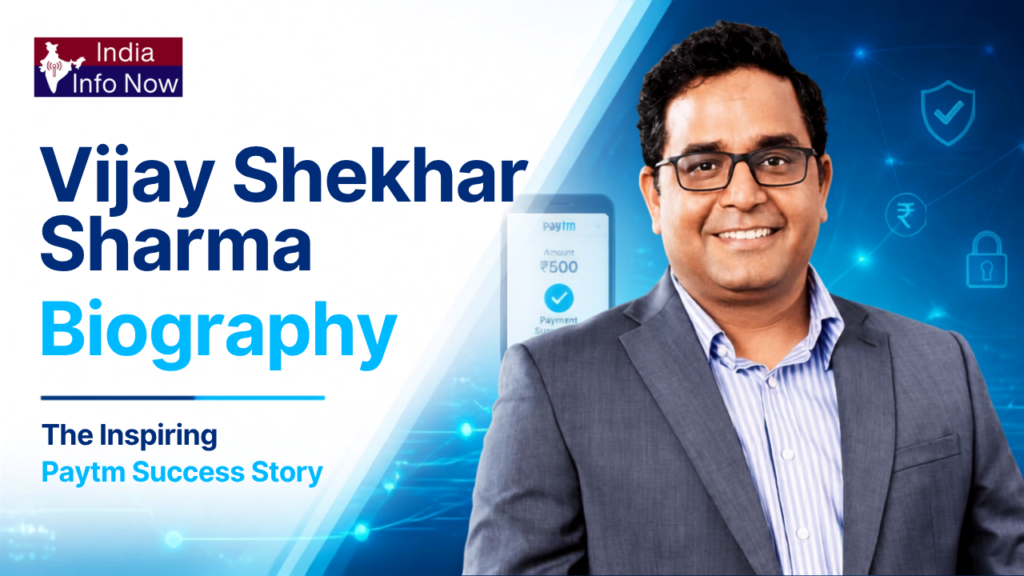
ToggleVijay Shekhar Sharma Biography: The Inspiring Paytm Success Story
Early Life and Education
Vijay Shekhar Sharma was born on 7 June 1978 in Aligarh, Uttar Pradesh. He was the third of four children in a family where his father, Sulom Prakash Sharma, was a schoolteacher, and his mother, Asha Sharma, was a homemaker.
He completed his schooling in Harduaganj, a small town near Aligarh. Coming from a Hindi-medium educational background, Sharma had to overcome a language barrier when he entered engineering college.
He enrolled at the Delhi College of Engineering, now known as Delhi Technological University, at a young age. He eventually graduated with an engineering degree.
His interest in computers and the internet emerged during his college years, at a time when India’s digital ecosystem was still in its early stages.
His First Entrepreneurial Experiment
While still in college, Sharma started his first website, indiasite.net, in 1997.
The website focused on internet-related content at a time when online businesses were still relatively new in India. Just two years later, Sharma sold the website for approximately US$1 million.
This early success gave him confidence that technology could create entirely new business opportunities.
However, instead of stopping after his first successful exit, Sharma continued looking for larger opportunities.
The Birth of One97 Communications
In 2000, Vijay Shekhar Sharma founded One97 Communications.
The company initially focused on providing mobile-content services, including news updates, cricket scores, ringtones, jokes, and examination results.
At that time, mobile phones were becoming increasingly popular in India, and Sharma saw an opportunity to build services around the growing mobile ecosystem.
One97 eventually became the parent company behind Paytm.
The Birth of Paytm
In 2010, Sharma launched Paytm, initially focusing on mobile recharge and digital payment services.
The name Paytm became associated with the idea of “Pay Through Mobile.”
The original concept was relatively simple: make it easier for Indian consumers to recharge their mobile phones and carry out digital transactions without depending entirely on cash.
Over time, Paytm expanded beyond mobile recharge into a much broader digital financial ecosystem.
Users could make payments, recharge mobile connections, pay utility bills, book services, and eventually access various financial and commerce-related products through the platform.
From Wallet to Digital Payments
One of the most important stages in Paytm’s growth was the expansion of its digital wallet.
The company worked aggressively to bring both consumers and merchants onto its platform.
Small businesses, shops, restaurants, street vendors, and other merchants were encouraged to accept digital payments using Paytm’s technology.
This merchant-focused strategy helped create a two-sided ecosystem:
Consumers → Paytm → Merchants
The more merchants accepted Paytm, the more useful the platform became to consumers. Likewise, a growing customer base encouraged more businesses to join.
This network effect became an important part of Paytm’s growth strategy.
Demonetization and the Digital Payment Boom
A major turning point for Paytm came in 2016, when the Indian government announced the demonetization of ₹500 and ₹1,000 currency notes.
The sudden shortage of cash encouraged millions of Indians to explore digital payment options.
Paytm was already established in the market, with a large network of consumers and merchants. As cash became difficult to access, the company’s wallet and digital payment services experienced a significant increase in visibility and usage.
The demonetization period became one of the most important catalysts in Paytm’s expansion.
However, Paytm’s growth was not based solely on demonetization. The company had already spent years building its technology, customer base, merchant network, and brand recognition.
Paytm gradually moved beyond payments.
The company expanded into several areas of financial services and digital commerce, including:
- Bill payments
- Insurance
- Digital banking-related services
- Investment and wealth-management products
- Stockbroking
- Lending-related services
- Online commerce
- Entertainment and ticketing
- Digital financial products
The objective was to create a broader ecosystem in which customers could access multiple financial and consumer services through connected digital platforms.
Paytm Mall and E-Commerce
In 2016, Paytm expanded into e-commerce with Paytm Mall.
The platform aimed to compete in India’s rapidly growing online shopping market, offering products across categories such as electronics, fashion, household goods, and consumer products.
Although e-commerce became a challenging and highly competitive sector, the move demonstrated Sharma’s ambition to build a much broader technology ecosystem rather than restricting Paytm to payments alone.
Funding and Strategic Partnerships
Paytm’s expansion was supported by major investors and strategic partnerships.
The company attracted investments from prominent global investors, including Alibaba, SoftBank, and Berkshire Hathaway, among others.
These investments provided capital that could be used to expand technology infrastructure, acquire customers, build merchant networks, and develop new products.
Partnerships with banks, financial institutions, brands, and merchants also helped Paytm strengthen its position in India’s growing digital economy.
Paytm's Business Model
Paytm’s business model has evolved significantly over time.
At its core, the platform connects consumers and merchants through digital technology.
Consumers use Paytm for payments and financial services, while merchants use its technology to accept payments and access business-related services.
The company has also developed additional revenue opportunities through financial services, merchant services, commerce, and other digital products.
This diversified approach reduced the company’s dependence on a single service and allowed it to participate in multiple areas of India’s digital economy.
Paytm's IPO Milestone
Another major milestone came in November 2021, when Paytm’s parent company, One97 Communications, went public.
The IPO raised approximately $2.5 billion and valued the company at around $19 billion at the time, making it India’s largest IPO at that point.
The public listing represented a remarkable transformation for a company that had started with mobile content and later became a major player in digital payments and financial technology.
Entrepreneurial Lessons from Vijay Shekhar Sharma
Vijay Shekhar Sharma’s journey provides several lessons for aspiring entrepreneurs.
Start early: His first internet venture began while he was still in college.
Solve everyday problems: Paytm initially focused on simple problems such as mobile recharge and digital payments.
Think beyond one product: The company continuously expanded into related services.
Build a strong network: Connecting consumers and merchants created a powerful digital ecosystem.
Adapt to change: Paytm repeatedly changed its business strategy as India’s technology and financial markets evolved.
Take calculated risks: Sharma entered emerging sectors when digital adoption was still developing in India.
Conclusion
Vijay Shekhar Sharma’s entrepreneurial journey is closely connected with the evolution of India’s digital economy.
From launching indiasite.net in 1997 and founding One97 Communications in 2000 to launching Paytm in 2010, his career demonstrates how an entrepreneur can evolve alongside rapidly changing technology.
Paytm’s journey from a mobile recharge and wallet platform to a broader fintech ecosystem illustrates the enormous transformation that took place in India’s financial technology sector.
For aspiring entrepreneurs, Sharma’s story offers a powerful message: a simple idea can become a large business when it solves a real problem, adapts to changing customer needs, and is supported by persistent execution.
Frequently Asked Questions
1. Who is Vijay Shekhar Sharma?
Vijay Shekhar Sharma is an Indian entrepreneur and the founder of One97 Communications, the company behind Paytm.Awais Ahmed is an Indian entrepreneur and the co-founder of Pixxel, a space-tech company focused on advanced Earth-observation and hyperspectral imaging technologies.
2. When was Vijay Shekhar Sharma born?
Vijay Shekhar Sharma was born on 7 June 1978 in Aligarh, Uttar Pradesh.
3. When was Paytm founded?
Paytm was launched in 2010 as a mobile recharge and digital payments platform.
4. What does Paytm stand for?
Paytm is commonly associated with the phrase “Pay Through Mobile.”
Most Popular
-
 தேர்வு நேரத்தில் குழந்தைகளுக்கு கொடுக்க வேண்டிய 10 மூளை ஆரோக்கிய உணவுகள்
 -
 அசைவ உணவுக்கு இணையான சத்துக்கள் தரும் சைவ உணவுகள் என்னென்ன?
 -
 நெல்லிக்காய் சாறு நன்மைகள் | Amla Juice Benefits in Tamil
 -
 காய்ச்சல் இருக்கும்போது குளிக்கலாமா? செய்ய வேண்டியது, தவிர்க்க வேண்டியது
 -
 சளி, இருமல் வராமல் இருக்க என்ன சாப்பிடலாம்? நோய் எதிர்ப்பு சக்தியை அதிகரிக்கும் உணவுகள்