
Table of Contents
ToggleArupadai Veedu Murugan Temples
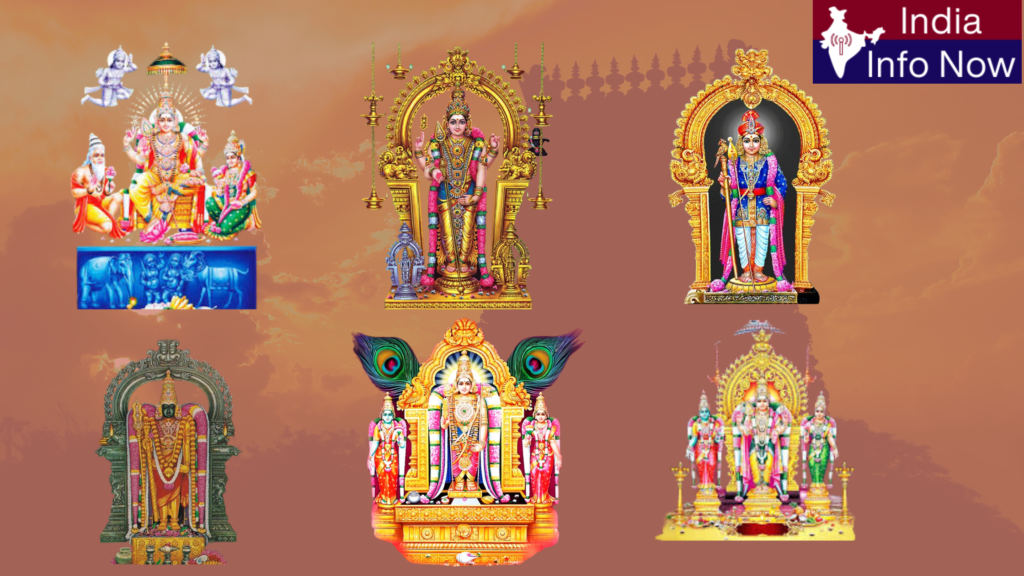
The Arupadai Veedu Murugan Temples, meaning “Six Battle Camps” or “Six Sacred Abodes,” are the most revered temples of Lord Murugan in Tamil Nadu. These temples are not merely places of worship but powerful spiritual landmarks that chronicle Murugan’s divine journey—from warrior and teacher to ascetic and householder.
According to Hindu scriptures, Lord Murugan, the son of Lord Shiva and Goddess Parvati, was appointed the commander of the celestial army to defeat the demon Soorapadman and restore cosmic balance. Each of the six abodes marks a significant event in this divine mission.
Beyond mythology, the Arupadai Veedu also symbolize humanity’s inner spiritual journey, representing the conquest of the six inner enemies (Arishadvargas):
Desire (Kama), Anger (Krodha), Delusion (Moha), Greed (Lobha), Pride (Mada), and Jealousy (Matsarya).
Pilgrims who visit these Arupadai Veedu Murugan temples believe they are not only honoring Murugan but also cleansing their mind and soul.
1. Thiruparankundram – The Divine Union
Thiruparankundram is the first abode of Lord Murugan and is revered as the site of his celestial marriage to Deivanai (Devasena), the daughter of Lord Indra, after defeating Soorapadman.
Built on a hillock, this ancient temple features remarkable rock-cut architecture, dating back to the Pandya period. The sanctum is carved directly into the mountain, making it one of the oldest Arupadai Veedu Murugan temples.
Spiritual Symbolism
This abode represents the union of karma and dharma, and the triumph of divine purpose over chaos.
🧘 Symbolism: Victory of righteousness, sacred union, and disciplined life.
| Details | Information |
|---|---|
|
Address |
Periya Ratha Veethi, Thiruparankundram, Madurai, Tamil Nadu 625005 |
|
Free Darshan |
Open to all devotees
|
|
Special Darshan |
Tickets can be purchased at the temple counter, with prices ranging from ₹10 to ₹300 per person |
|
Timing |
5:30 AM to 1 PM & 4 PM to 8:30 PM |
|
Online Booking |
Not available |
Thiruchendur is the only seaside Murugan temple among the six sacred abodes. This is where Lord Murugan waged his epic war against Soorapadman and destroyed evil using his divine spear, the Vel.
The temple stands majestically beside the Bay of Bengal, where the rhythmic sound of waves enhances the spiritual atmosphere. The grand Kanda Sashti festival, which reenacts this battle, draws millions of devotees every year.
Spiritual Symbolism
This temple teaches the destruction of inner darkness and fear.
🧘 Symbolism: Courage over chaos, purity over corruption.
| Details | Information |
|---|---|
|
Address |
South car Street Tiruchendur – 628 215 |
|
Free Darshan |
Open to all devotees
|
|
Special Darshan |
Tickets can be purchased at the temple counter, with prices ranging from ₹10 to ₹300 per person |
|
Timing |
5:30 AM to 12 PM & 4 PM to 9 PM |
|
Online Booking |
Available |
3. Palani – The Path of Renunciation
At Palani, Lord Murugan is worshipped as Dhandayuthapani Swamy, the youthful ascetic holding a staff (danda). According to legend, Murugan renounced his family after losing the divine fruit contest to Lord Ganesha and chose solitude over pride.
Perched atop a hillock, Palani is one of the most visited Arupadai Veedu Murugan temples in South India, famous for its sacred Panchamirtham prasadam.
Spiritual Symbolism
Palani represents the surrender of ego and pursuit of true wisdom.
🧘 Symbolism: Letting go of pride, awakening of inner knowledge (Gnana).
| Details | Information |
|---|---|
|
Address |
Giri Veethi, Palani, Tamil Nadu – 624601 |
|
Free Darshan |
Open to all devotees
|
|
Special Darshan |
Tickets can be purchased at the temple counter, with prices ranging from ₹10 to ₹300 per person |
|
Timing |
05:30 AM – 12:25 PM & 12:30 PM – 09:00 PM |
|
Online Booking |
Not Available |
4. Swamimalai – The Guru Within
Swamimalai is one of the Arupadai Veedu Murugan temples and holds a unique position as the place where young Murugan explained the meaning of the sacred syllable “Om (Pranava Mantra)” to Lord Shiva himself.
This divine role earned Murugan the title “Swaminatha” – the teacher of the teacher.
The temple is built on an artificial hill with 60 steps, symbolizing the 60 Tamil years.
Spiritual Symbolism
This abode emphasizes that wisdom is not bound by age or status.
🧘 Symbolism: Inner knowledge, humility, spiritual authority.
| Details | Information |
|---|---|
|
Address |
kumbeswaran thirumanjana veedhi, Swamimalai, Kumbakonam, 612302 |
|
Free Darshan |
Open to all devotees
|
|
Special Darshan |
Tickets can be purchased at the temple counter, with prices ranging from ₹5 to ₹500 per person |
|
Timing |
5 AM to 12 PM & 4 PM to 9 PM |
|
Online Booking |
Available |
5. Thiruthani – The Peace After the Storm
After fierce battles, Murugan retreated to Thiruthani to find peace and emotional healing. It is also believed to be the place where he married Valli, the tribal princess.
The temple stands atop a hill with 365 steps, representing the days of the year.
Spiritual Symbolism
This abode represents calmness after conflict and the return to harmony.
🧘 Symbolism: Emotional balance, rest, renewal of the soul.
| Details | Information |
|---|---|
|
Address |
Thiruthani Hill, Thiruttani 631209 |
|
Free Darshan |
Open to all devotees
|
|
Special Darshan |
Tickets can be purchased at the temple counter, with prices ranging from ₹10 to ₹200 per person |
|
Timing |
5:30 AM to 1:00 PM & 4 PM to 9 PM |
|
Online Booking |
Available |
Nestled in lush forests, Pazhamudircholai is where Murugan is worshipped with both his consorts – Valli and Deivanai.
This temple is closely associated with the great Tamil poet Avvaiyar, whom Murugan tested and blessed with divine wisdom.
Unlike the other hill temples, this shrine lies amidst fertile greenery, symbolizing abundance.
Spiritual Symbolism
It represents the integration of worldly life and spiritual wisdom.
🧘 Symbolism: Wholeness, harmony of love and knowledge.
| Details | Information |
|---|---|
|
Address |
Alagar Hills, Bazaar, Madurai-625001 |
|
Free Darshan |
Open to all devotees
|
|
Special Darshan |
Tickets can be purchased at the temple counter, with prices ranging from ₹10 to ₹100 per person |
|
Timing |
5:30 AM to 1:00 PM & 4 PM to 9 PM |
|
Online Booking |
Not Available |
Spiritual Importance of Arupadai Veedu Murugan Temples
Together, the six sacred abodes reflect the following:
- Murugan as warrior, teacher, ascetic, husband, and healer
- The journey from ignorance to enlightenment
- The conquest of the six inner enemies
- The balance between duty, devotion, and wisdom
Pilgrims believe that visiting all six sacred abodes completes a sacred spiritual cycle that purifies the soul and brings divine grace.
Conclusion
The Arupadai Veedu Murugan Temples are not just temples; they are living scriptures carved in stone, narrating Murugan’s divine mission and humanity’s spiritual evolution. Each shrine offers a lesson—courage, humility, renunciation, wisdom, peace, and balance.
Frequently Asked Questions
1. What are the names of the Arupadai Veedu Murugan temples?
- Thiruparankundram – Madurai
- Thiruchendur – Thoothukudi
- Palani – Dindigul
- Swamimalai – Kumbakonam
- Thiruthani – Tiruvallur
- Pazhamudircholai – Madurai
2.Why are these temples important?
Each temple marks a significant event in Lord Murugan’s life such as his victory over Soorapadman, marriages, teachings, renunciation, and spiritual rest.
3. Which Arupadai Veedu Murugan temple is near the sea?
Thiruchendur is the only one among Arupadai Veedu Murugan temples located on the seashore.
4.Which temple is associated with Murugan teaching “Om”?
Swamimalai is where Murugan explained the Pranava Mantra (Om) to Lord Shiva.
Most Popular
-
 தினமும் முட்டை சாப்பிடலாமா? நன்மைகள், கொலஸ்ட்ரால் மற்றும் யாரெல்லாம் கவனமாக இருக்க வேண்டும்?
 -
 இரவில் சாப்பிடக்கூடாத உணவுகள் என்ன? தூக்கத்தை பாதிக்கும் 7 உணவுகள்
 -
 தினமும் நடப்பதால் ஏற்படும் மாற்றங்கள் | நடைப்பயிற்சி நன்மைகள்
 -
 காலை எழுந்தவுடன் தண்ணீர் குடிப்பது நல்லதா? முழு தகவல்
 -
 தேர்வு நேரத்தில் குழந்தைகளுக்கு கொடுக்க வேண்டிய 10 மூளை ஆரோக்கிய உணவுகள்