
Table of Contents
ToggleSriharsha Majety Success Story | How Swiggy Started
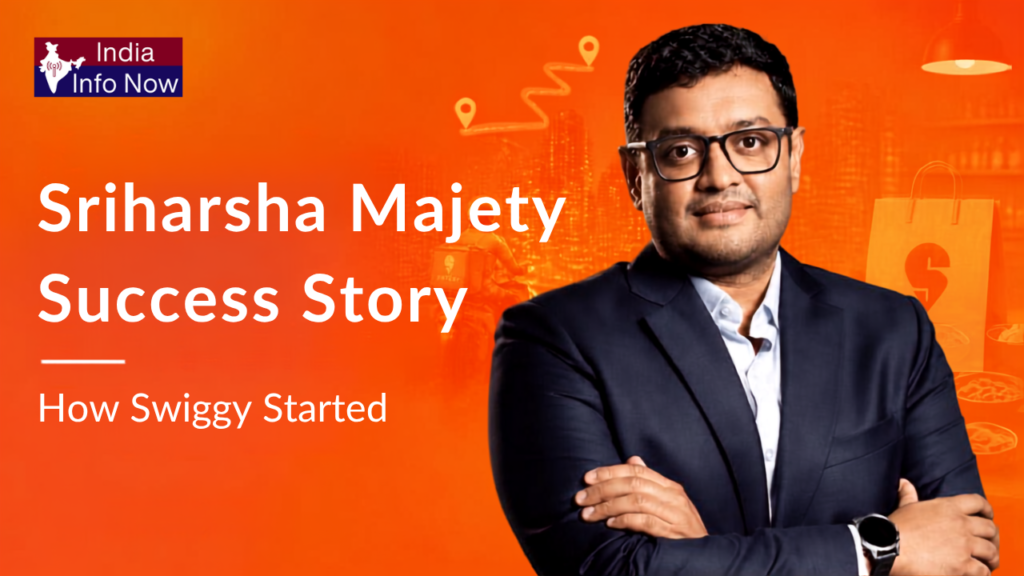
Education and Early Years
Sriharsha Majety was born in Vijayawada, Andhra Pradesh. He completed his engineering education at BITS Pilani, specializing in Electrical and Electronics Engineering.
After graduating, he pursued an MBA at the Indian Institute of Management Calcutta (IIM Calcutta). His combination of engineering and management education gave him exposure to both technology and business strategy.
Rather than following a conventional corporate career for the long term, Majety remained interested in entrepreneurship and emerging business opportunities.
Experience in the Financial Sector
After completing his education, Majety began his professional career in the financial industry. He worked as a trader at Nomura International in London, where he gained experience in financial markets, risk management and decision-making in a highly competitive environment.
Although the experience offered valuable professional exposure, Majety continued to be interested in building something of his own.
When he returned to India, he began exploring entrepreneurial opportunities. His interest eventually moved toward India’s rapidly expanding e-commerce ecosystem and, more specifically, the logistics problems associated with online businesses.
The First Startup: Bundl
India’s e-commerce sector was growing quickly, but efficient logistics and last-mile delivery remained significant challenges.
Majety joined forces with his college friend Nandan Reddy to explore opportunities in the logistics space. Together, they started Bundl, a logistics and courier aggregation venture.
The idea was to create a business that combined technology with physical delivery operations. This experience exposed Majety and his team to the practical challenges of logistics, including coordination, delivery operations and customer expectations.
Although Bundl was not the final business that made Majety widely known, it became an important stepping stone in his entrepreneurial career.
The experience helped the founders understand the potential of technology-enabled logistics and the growing demand for convenient delivery services.
The Beginning of Swiggy
In 2014, Majety teamed up with Nandan Reddy and Rahul Jaimini to launch Swiggy in Bengaluru.
The company began with a straightforward objective: make it easier for customers to order food from restaurants and have it delivered to their homes.
At the time, India’s online food-delivery sector was still developing. Several companies were attempting to solve the challenge of connecting restaurants, customers and delivery services.
Swiggy adopted a distinctive approach by investing in its own delivery network. Instead of relying entirely on restaurants to manage deliveries, the company built greater control over its logistics operations.
This helped Swiggy focus on delivery reliability, speed and customer experience while allowing restaurants to concentrate on preparing food.
Growing Into a Major Consumer Platform
As Swiggy gained traction, it expanded beyond Bengaluru into additional Indian cities.
The company attracted funding from prominent investors, which supported its efforts to strengthen technology, expand its delivery network and enter new markets.
The business continued to evolve as Indian consumers became increasingly comfortable using smartphones and digital platforms for everyday purchases.
Swiggy’s growth was not limited to restaurant food delivery. The company began exploring additional categories where its technology and logistics capabilities could provide convenience.
One of its significant expansions was Swiggy Instamart, which focused on delivering groceries and everyday essentials quickly. Another service, Swiggy Genie, enabled users to request various local pick-up and delivery services.
These initiatives reflected the company’s broader ambition to become part of consumers’ everyday lives rather than remaining solely a restaurant food-ordering platform.
Adapting to Changing Consumer Needs
A major feature of Majety’s entrepreneurial journey is the company’s willingness to change and expand its business model.
The original Swiggy proposition centered on restaurant food delivery. However, consumer expectations evolved, and demand for fast delivery expanded into groceries, essentials and other local services.
Swiggy responded by using its existing technology, customer base and delivery infrastructure to explore these adjacent markets.
This approach illustrates an important principle in entrepreneurship: a company’s original product does not necessarily have to define its entire future.
Businesses can discover new opportunities by closely observing how customers use their services and what additional problems they need solved.
Building a large food-delivery platform requires much more than developing a mobile application.
Swiggy’s operations involve customers, restaurants, delivery partners, technology systems and logistics networks working together.
Maintaining a smooth experience across all these areas requires substantial operational coordination.
Majety’s role involved not only shaping the company’s broader strategy but also overseeing its evolution as the business operated at increasing scale.
His background in engineering, business management and financial markets provided exposure to different aspects of decision-making and business development.
Entrepreneurial Lessons From Sriharsha Majety
Majety’s career offers several lessons for aspiring entrepreneurs.
1. Start by identifying a problem
The early focus on logistics emerged from a real challenge in India’s growing e-commerce industry.
2. Early ventures can provide valuable experience
Bundl gave the founders practical exposure to technology-enabled logistics before they built Swiggy.
3. Technology and operations must work together
A digital platform becomes useful only when its underlying operational system can deliver a consistent customer experience.
4. Be prepared to evolve
Swiggy’s movement from food delivery into groceries and other services demonstrates the importance of adapting to market changes.
5. Customer convenience can create strong opportunities
Reducing the time and effort required for everyday tasks has been central to the growth of digital delivery businesses.
Conclusion
Sriharsha Majety’s story is an example of an entrepreneurial journey shaped by education, professional experience, experimentation and adaptation.
His path moved from engineering and an international financial career to an early logistics venture and eventually to the creation of Swiggy.
What began as an attempt to make restaurant food delivery more convenient developed into a much broader consumer technology and delivery platform.
The journey also shows that entrepreneurship rarely follows a perfectly straight path. Early ideas can provide lessons, unexpected challenges can create new directions, and businesses can evolve as customer needs change.
For aspiring entrepreneurs, Majety’s career highlights the value of identifying genuine problems, learning from early experiences, focusing on execution and remaining open to new opportunities.
Frequently Asked Questions
1. Who is Sriharsha Majety?
Sriharsha Majety is an Indian entrepreneur and co-founder and CEO of Swiggy.
2. What is Sriharsha Majety known for?
He is primarily known for co-founding Swiggy and leading its growth as a technology-driven food and convenience platform.
3. What did Sriharsha Majety do before Swiggy?
Before Swiggy, Majety worked as a trader at Nomura International in London and later explored entrepreneurship in the logistics sector.
4. What was Bundl?
Bundl was an early logistics and courier aggregation venture started by Sriharsha Majety and Nandan Reddy before Swiggy.
Most Popular
-
 கும்பகோணம் சாரங்கபாணி கோவில் – வரலாறு, தலப்பெருமை, வழிபாடு, நேரம் மற்றும் செல்லும் வழி
 -
 திருவரங்கம் அரங்கநாதர் கோயில் – 7 பிரகாரங்கள், வரலாறு, சிறப்புகள்
 -
 Sriharsha Majety Success Story | How Swiggy Started
 -
 Sameer Nigam Entrepreneurial Journey: The Story Behind PhonePe
 -
 Vineeta Singh Success Story: From ₹1 Crore Job Offer to SUGAR Cosmetics